Freelancing vs Entrepreneurship: Which Career Path Is Right for You?
Table of Contents
 The modern workforce has shifted a lot in the last ten years. We don't just see the old-fashioned 9-to-5 anymore; there are other ways to succeed now. With tech, people can work from home or start online gigs, allowing for more personal control in job choices.
Two of the most popular options are freelancing and entrepreneurship. While these terms are often used interchangeably, they represent very different approaches to earning income and building a career.
Freelancers usually sell their skills straight to clients, whereas entrepreneurs build businesses that run on their own. Both routes give flexibility and freedom, along with chances to grow. Yet, each comes with its set of challenges and cool perks too.
If you're considering becoming your own boss, understanding the differences between freelancing and entrepreneurship can help you make an informed decision.
What Is Freelancing?
Freelancing is being self-employed, where folks offer their skills to clients for specific projects or contracts. Instead of one boss, freelancers work for many different clients and get paid for their know-how.
Common freelance professions include:
Content writing
Graphic design
Web development
Digital marketing
Video editing
Virtual assistance
Photography
Social media management
Consulting
Freelancers usually manage every aspect of their work, including finding clients, completing projects, handling communication, invoicing, and maintaining relationships.
How Freelancing Works
Freelancers trade their time, skills, and know-how for cash. Like, a freelance writer earns by crafting blog posts, whereas a web developer creates sites for companies.
Their pay is directly linked to the workload. More projects mean higher earnings. But taking on too much can burn out a freelancer, you know? So, balancing the workload is key.
Benefits of Freelancing

1. Low Startup Costs
Most freelancers only need a computer, internet connection, and relevant skills to begin working.
2. Flexible Schedule
Freelancers can often choose when and where they work.
3. Quick Income Potential
Unlike businesses that may take months or years to generate profit, freelancers can start earning soon after securing clients.
4. Independence
Freelancers have control over their workload, clients, and rates.
Challenges of Freelancing
1. Income Instability
Work availability may fluctuate from month to month.
2. Limited Scalability
Income is often tied directly to personal effort and available working hours.
3. Client Dependency
Losing a major client can significantly affect earnings.
4. Multiple Responsibilities
Freelancers handle marketing, accounting, project management, and customer service themselves.
What Is Entrepreneurship?
Entrepreneurship means creating and growing a business by building systems, products, or services that earn more than just the hours an entrepreneur puts in.
Instead of selling their time, entrepreneurs develop something that creates value and can run with less constant input from them.
Examples of entrepreneurs include:
E-commerce store owners
SaaS founders
Agency owners
Restaurant owners
Startup founders
Product creators
Online course creators
Entrepreneurs identify market opportunities, develop solutions, and build businesses designed for long-term growth.
How Entrepreneurship Works
Entrepreneurs make things or offer services, then set up ways to earn cash from them. They might employ people, outsource jobs, or use automation for growth.
Building a business differs from freelancing because it's about creating assets that keep making money, even when you take a break.
Benefits of Entrepreneurship

1. Unlimited Growth Potential
Businesses can scale beyond the founder's personal time limitations.
2. Asset Creation
Entrepreneurs build valuable companies that may eventually be sold or expanded.
3. Multiple Revenue Streams
Businesses often generate income from various products, services, and markets.
4. Greater Financial Opportunities
Successful businesses can produce significantly higher profits than most freelance careers.
Challenges of Entrepreneurship
1. Higher Risk
Starting a business often requires financial investment and involves uncertainty.
2. Longer Time to Profitability
Many businesses take months or years to become profitable.
3. Increased Responsibility
Entrepreneurs manage employees, finances, operations, and strategic planning.
4. Greater Stress Levels
Business ownership often involves complex decision-making and risk management.
Freelancing vs Entrepreneurship: Key Differences
Both paths mean being your own boss but freelancing and entrepreneurship aren't the same thing.
1. Income Structure
Freelancing: Income comes from providing services and is usually based on hourly rates, project fees, or retainers.
Entrepreneurship: Income comes from business operations, products, systems, and scalable revenue models.
2. Scalability
Freelancing: Growth is often limited by available working hours.
Entrepreneurship: Businesses can grow through automation, hiring, and expansion.
3. Risk Level
Freelancing: Lower financial risk due to minimal startup costs.
Entrepreneurship: Higher risk because of investments, operational expenses, and market uncertainty.
4. Workload
Freelancing: The freelancer performs most client work personally.
Entrepreneurship: Entrepreneurs focus on leadership, strategy, and business development.
5. Long-Term Value
Freelancing: Income stops when work stops.
Entrepreneurship: Businesses can become valuable assets with long-term earning potential.
Skills Required for Freelancing
To succeed as a freelancer, individuals need both technical and business skills.
Essential Freelance Skills
Communication
Time management
Client relationship management
Marketing and networking
Project management
Negotiation
Industry expertise
Successful freelancers consistently improve their skills and build strong professional reputations.
Skills Required for Entrepreneurship
Entrepreneurs need a broader skill set focused on business growth and leadership.
Essential Entrepreneurial Skills
Strategic thinking
Leadership
Financial management
Problem-solving
Marketing
Sales
Decision-making
Team building
Entrepreneurs must often learn how to manage people, systems, and resources effectively.
Financial Comparison: Freelancing vs Entrepreneurship
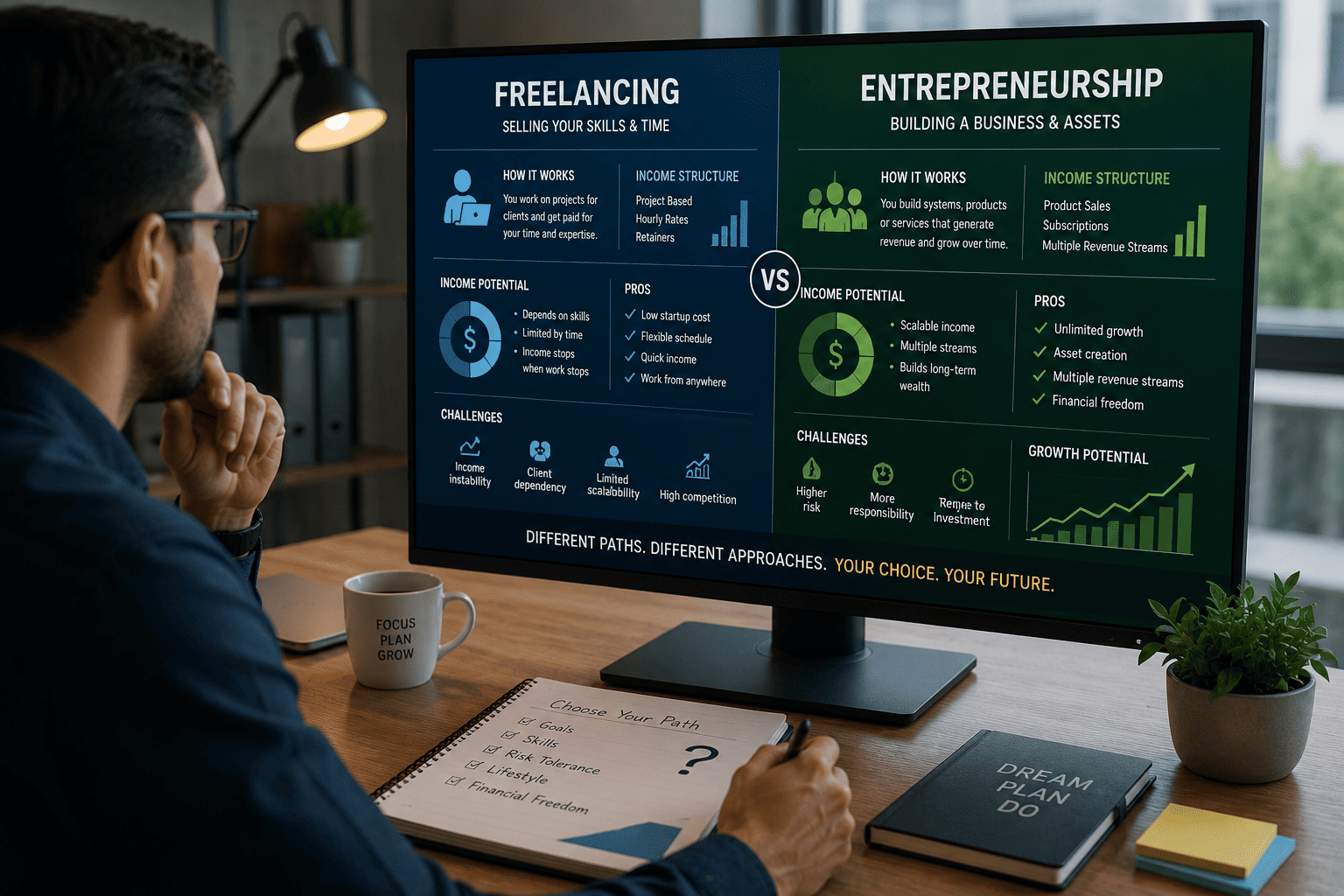
Financial outcomes differ a lot between freelancing and entrepreneurship.
Freelancing Income Potential
Freelancers often start making money fast too. Skilled folks in software, consulting, design, and content creation can earn serious cash, though sometimes their extra information doesn't load right.
However, earnings generally depend on:
Hourly rates
Number of clients
Available work hours
Experience level
Market demand
Because time is limited, income growth eventually reaches a ceiling.
Entrepreneurship Income Potential
Entrepreneurs may experience slower initial growth but greater long-term earning potential.
A successful business can generate revenue through:
Product sales
Subscriptions
Licensing
Advertising
Partnerships
Service offerings
Since businesses can scale, income is not necessarily tied to personal working hours.
Conclusion
Deciding between freelancing and entrepreneurship hinges on your goals, skills, and how comfortable you are taking risks. Freelancing gives you flexibility, low startup costs, and quicker ways to earn money. Being an entrepreneur means more room to grow and scale up in the long run. Either can work if you're dedicated and keep learning. Think hard about what matters most to you and pick the path that fits your plans best.
Frequently Asked Questions
Tags

Sharik Rasool
Verified AuthorSenior Freelance SEO & Editorial Link Building Specialist
Sharik Rasool is a senior SEO strategist and manual outreach link builder with over 8 years of hands-on experience scaling search rankings for SaaS, tech startups, and digital publishers. Having secured 500+ high-authority DR50–85+ editorial placements, he specializes in data-backed technical audits, competitor backlink gap matrices, and white-hat outreach systems.